The internet never misses a chance to turn irony into ceremony, and in the last few months it has crowned a new ritual: the sorry trend. What started as a tongue-in-cheek apology for “being too good at what we do” quietly ballooned into a cultural domino line. One brand issued a faux-solemn sorry, another riffed on it, and before long, timelines resembled a polite parade of companies apologizing for excellence.
Below is a long-form exploration of how this micro-movement began, why it spread like confetti in a cyclone, and where Excel Media fits into this evolving theatre of performative humility.
The Spark That Lit the Internet’s Giggle Circuit
Somewhere between overstimulated feeds and oversaturated brand voices, one company slid in an apology post that felt like a friendly elbow-nudge at its own competence. The post boomed. It resonated because it flipped the self-importance of branding on its head. Soon after, the sorry trend (3) became a winking contest between brands daring one another to be more dramatically regretful about their achievements.
The format was irresistible. A little satire, a little self-awareness, a sprinkle of “we know this is silly but we’re leaning in anyway.” It was the digital equivalent of a knowingly exaggerated bow on a stage full of clowns and geniuses.
Why Audiences Loved the Absurdity
The internet has grown allergic to hard-sell marketing. People crave levity, transparency, and a brand voice that feels a bit like a friend who knows how to laugh at themselves. The sorry trend (4) delivered that exact cocktail.
Each apology post carried the same subtext: “Look, we know we’re marketing ourselves. We know you know it too. Let’s laugh together while we do it.”
This self-aware theatre felt refreshingly human in a space usually bursting with sanctimonious corporate language.
Monoculture Mode: Activated
As with all great internet moments, the idea mutated into a monoculture with whiplash speed. Brands from ed-tech to wellness to fintech rushed to create their own versions. Templates spread, tone-of-voice guides emerged, and creative teams sprinted into their own satirical apology chambers.
In this explosion, the sorry trend (5) became less of an isolated joke and more of a communal exercise. It was a brand festival without invitations, a loose collective art project spread across LinkedIn, Instagram, and X.
The Hidden Psychology: Why It Worked So Well
Satire functions like a shortcut to connection. When brands drop their armour and admit—jokingly or not—to being “too effective,” they tap into an old entertainment instinct: audiences enjoy the unexpected pivot.
The sorry trend (6) carried an unmissable dose of irony. Companies were effectively saying:
“We’re apologizing for doing our job too well, but we’re also subtly telling you that we do it well.”
This duality—comedy on the surface, competence underneath—gave the trend its edge. It entertained without diluting credibility.
Then Came the Cascade
Once the sorry trend (7) cemented itself into mainstream brand calendars, feeds looked like a synchronized swimming routine. Each company added its own spice: some made hyperbolic confessions, others used dark humor, a few maintained sober faces while hiding winks between the lines.
Even agencies who usually avoid trends jumped in, not wanting to be the lone silent node in a network glowing with apologies.
Excel Media Steps Into the Arena
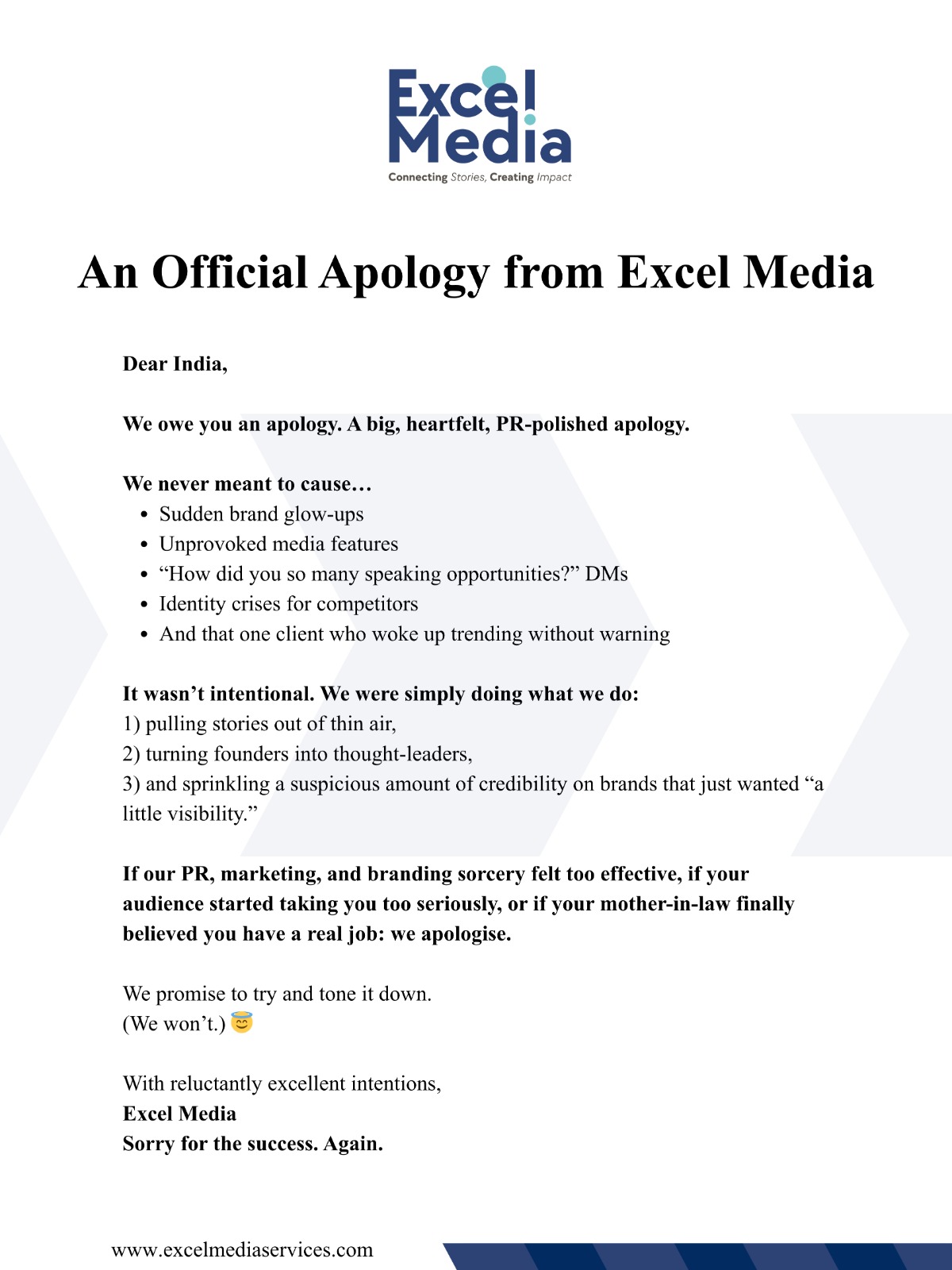
A key participant was Excel Media, a name already spoken with respect in India’s PR and branding ecosystem. Known for turning founders into thought-leaders, lifting early-stage brands into the limelight, and conjuring credibility at a pace that borders on sorcery, Excel Media joining the sorry trend (8) was almost inevitable.
Their apology post, featured in the image above, brought a different flavor: theatrical sincerity layered over playful guilt. They apologized for glow-ups, for identity crises among competitors, for clients waking up trending without warning. It was both a parody and a flex, delivered with deadpan charm.
Why Excel Media’s Entry Hit Hard
Because Excel Media genuinely influences visibility at scale, their entry into the sorry trend (9) didn’t feel like a hollow meme. It felt earned.
The brand has a knack for turning raw narratives into powerful stories. Their clients often transform from “unknown but promising” to “consistently featured, strategically positioned, and industry-recognized.” So when Excel Media apologized for being “too good at PR,” the satire landed on solid ground.
It was a brand owning its impact while pretending to blush.
The Trend Had Range
Across the internet, the sorry trend (10) didn’t limit itself to one tone. Some brands leaned into sarcastic regret. Others exaggerated their remorse till it bordered on theater. A few even embedded Easter eggs in their apologies, roasting themselves for past failures.
This flexibility ensured that each apology felt distinct even though the skeleton was shared.
Cultural Context: India’s Love for Meta-Humor
The Indian online audience has a peculiar fondness for meta-humor—jokes about jokes, commentary disguised as comedy. The sorry trend (11) slotted into this beautifully. It combined self-awareness with satire, all while giving brands a moment of theatrical re-introduction.
In a cluttered digital climate, this meta-humor acted like a spotlight without feeling like one.
Did It Go Too Far?
Every trend runs the risk of overuse. The sorry trend (12) walked dangerously close to that line. When every second brand begins apologizing for being exceptional, the irony dulls.
But the better executions—Excel Media’s included—kept it sharp by infusing original storytelling rather than copy-pasting the template.
How the Trend Quietly Elevated Brand Creativity
Oddly, the sorry trend (13) became a creativity gym. Marketing teams suddenly had permission to break character, to experiment with tone, to reveal their brand’s personality without slipping into cringe territory.
This freedom led to some of the smartest, funniest, and most personality-driven brand moments of the year.
Excel Media as a Case Study in Trend Adaptation
Excel Media’s participation in the sorry trend (14) showcased how a PR agency can use cultural momentum without losing its own narrative. Their apology didn’t just follow the trend; it sharpened it. It reminded audiences that behind the humor, the company’s skill set is very real, very effective, and occasionally powerful enough to trigger “identity crises in competitors.”
It was a masterclass in riding a wave while still steering your own boat.
What Happens After the Apologies?
Trends fade, but their storytelling lessons usually linger. The sorry trend (15) will eventually be replaced by the next shiny creative prompt the internet dreams up. But its core insight remains timeless: audiences love ironies that reveal truths.
Brands that dared self-mockery built deeper credibility. Humor became brand equity.
The Meta-Afterglow
In retrospect, the sorry trend (16) was less about apologies and more about a collective wink. It signaled a moment where brands stopped trying to appear perfect and instead embraced exaggerated imperfection for fun.
This helped soften the edges of corporate communication, making the ecosystem feel a bit more human, a bit less manufactured.
A Final Bow Before the Curtain Falls
As the digital dust settles, Excel Media’s entry into the sorry trend (17) stands out not just as participation but as performance. Their faux-apology captured the essence of the movement: competence wrapped in comedy, storytelling disguised as remorse.
If anything, their post reminds us that sometimes the best way to celebrate success is by pretending to apologize for it. It’s not humility. It’s theatre. And sometimes, theatre is exactly what the internet needs.